
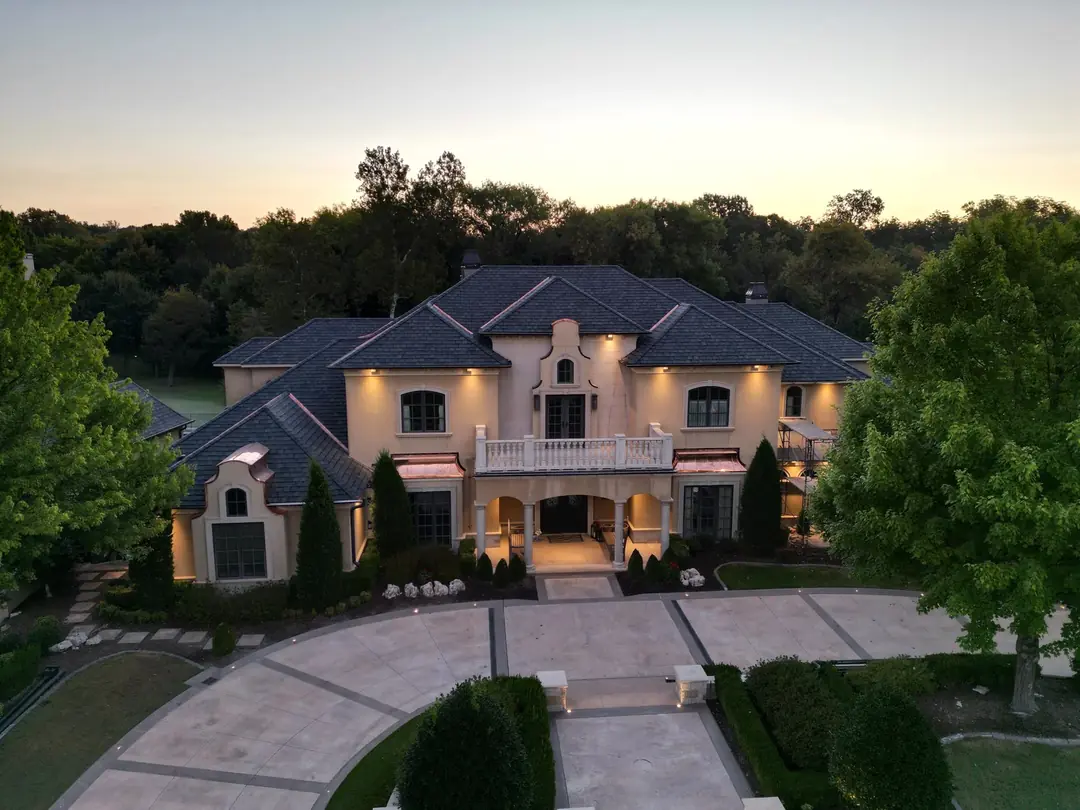
Slate Roofing 101: A Beginner's Guide
How real slate roofs are made and installed, why they last 75 to 150 years, what they cost in Tulsa in 2026, and when synthetic slate is the smarter choice.

The short answer: Real slate is quarried stone that can last 75 to 150 years, but it costs roughly $1,500 to $3,500 per square installed in Tulsa, weighs 700 to 1,000 pounds per square, and needs specialized installers and framing that can carry the load. Synthetic slate costs about a third to half as much, weighs a fraction of that, and quality products carry Class 4 hail and Class A fire ratings, which makes it the practical choice for most Oklahoma homes.
In this guide 12 sections
- What Slate Actually Is
- How Slate Becomes a Roof
- Why Slate Lasts So Long
- Installation Requirements
- The Cost of Real Slate
- Synthetic Slate: The Modern Alternative
- Maintenance of Slate Roofs
- Slate Roofs in Oklahoma
- When Slate Makes Sense
- Identifying Quality Slate
- Frequently Asked Questions About Slate Roofs
- The Bottom Line
Slate is the longest-lasting roofing material in widespread residential use. A properly installed slate roof can last 75-150 years: outliving the homeowner, the original mortgage, and often the rest of the structure beneath it. Slate roofs in the northeastern United States routinely date back to the 1880s and continue to perform.
In the Tulsa metro, real slate is uncommon, but synthetic slate alternatives have grown significantly in the past two decades and now compete on look while offering different cost, weight, and installation characteristics. Understanding what real slate is, what makes it last so long, and how it compares to synthetic alternatives helps homeowners considering this premium category make informed choices.
This guide explains slate roofing fundamentals: what slate actually is, where it comes from, how it is installed, what makes a slate roof last so long, the comparison between real and synthetic slate, and where each makes sense in a Tulsa-area home.
For broader material context, see our companion article on the best roofing materials for Tulsa homes.
What Slate Actually Is
Slate is a fine-grained metamorphic rock formed from compacted shale subjected to heat and pressure over geologic time. The defining property of slate is its cleavage: the rock splits cleanly along parallel planes when struck with a chisel, allowing it to be quarried in thin, flat sheets ideal for roofing.
The slate used for roofing is mined from specific quarries with the right geological history to produce high-quality split material. The major North American sources are Vermont (specifically the Granville and Poultney areas), Pennsylvania (Slatington and Pen Argyl), and historically Virginia and Maine.
Internationally, Spain and Wales are also major sources, with Welsh and Spanish slate exported worldwide.
Each quarry produces slate with distinct color characteristics. Vermont slate ranges from grey to green to purple to red depending on the specific bed. Pennsylvania slate is typically dark grey to black. Welsh slate is usually a fine-grained dark blue-grey. The color comes from mineral content, iron oxides, chlorite, manganese, and is permanent for the life of the stone.
How Slate Becomes a Roof
Slate quarrying and processing remain heavily manual processes. The basic stages:
- First, blocks of slate are quarried from the bedrock using saws or controlled blasting. Quality quarries produce relatively large, intact blocks that can be split into individual slate roofing tiles.
- Second, the blocks are split. A skilled splitter uses a chisel and mallet to drive along the natural cleavage planes of the slate, producing flat sheets typically 1/4 to 3/8 inch thick. The splitting process is highly skilled: a splitter who knows the stone can produce more roof slates per block than one who does not.
- Third, the split slates are sized and trimmed. Roofing slates are typically rectangular, 6-12 inches wide and 10-24 inches long. Edges are trimmed with a slate cutter (similar to a paper guillotine) to produce a clean edge.
- Fourth, holes are punched for installation fasteners. Each slate is punched with two holes near its top edge for nails. Quality fabricators punch the holes accurately to ensure proper coverage when installed.
Why Slate Lasts So Long
Several properties make slate the longest-lived roofing material:
- Geological permanence. Slate is rock. It does not weather quickly, does not degrade in UV, does not absorb significant water, and does not change dimension with temperature. The material itself is essentially permanent on residential timescales.
- Density and water resistance. Quality slate has water absorption below 0.25%: among the lowest of any natural building material. Water does not penetrate the slate; it sheets off the surface.
- Fire resistance. Slate is a Class A fire-rated material. It will not ignite or contribute to a fire, which has historically made slate the material of choice for institutional and government buildings.
- No biological vulnerability. Slate is not vulnerable to fungal decay, insect damage, or other biological deterioration. Moss and lichen can grow on the surface but cannot damage the stone itself.
- Wind resistance. Properly installed slate is mechanically attached with copper or stainless steel nails. The fastener system, not the stone, determines wind performance, and heavy, well-nailed slate rarely blows off.
Installation Requirements
Slate is a heavy and demanding material to install. A square of slate (100 square feet of roof) weighs 700-1,000 pounds, compared to 200-300 for asphalt shingles. The structural framing of the home must be designed to support that load. Most modern code-built homes can handle it, but older homes or homes designed for lighter roofing may require structural reinforcement.
Installation is also slow and requires skilled craftspeople. Slates are nailed one at a time, with each course overlapping the previous, and each slate hand-cut to fit around penetrations, valleys, and edges. A residential slate roof can take weeks to install, where an asphalt shingle roof of the same size takes days.
Underlayment for slate is also different. Quality slate installations use either heavy felt or copper as the underlayment: chosen because the underlayment may need to outlast the original installation cycle. The NRCA Roofing Manual provides detailed specifications for slate installation, including underlayment, fastener type, and exposure requirements.
The Cost of Real Slate
Real slate is one of the most expensive roofing materials available. In the Tulsa metro in 2026, expect installed costs of $1,500-$3,500 per square: more than five times the cost of asphalt shingles. A typical 30-square home would run $45,000-$105,000 for slate, compared to $13,000-$22,000 for architectural asphalt.
The cost premium reflects multiple factors:
- Material cost: quality slate is expensive at the quarry and expensive to ship
- Installation labor: slate installation requires specialized training and craftsmanship; few crews in any market are qualified
- Structural requirements: heavier framing or reinforcement may be needed
- Specialty flashings and fasteners: slate requires copper or stainless steel hardware to match the multi-generational life of the stone
Synthetic Slate: The Modern Alternative
Because real slate is so expensive and structurally demanding, synthetic slate alternatives have grown significantly in the past two decades. Companies including DaVinci Roofscapes, EcoStar, Brava, and others manufacture polymer-based products designed to imitate the look of real slate at one-third to one-half the cost and one-quarter the weight.
Synthetic slate offers:
- Visual appearance comparable to real slate from normal viewing distances.
- Significantly lower weight (200-300 lb per square vs. 700-1,000 for real slate).
- Lower material cost ($800-$1,500 per square installed vs. $1,500-$3,500).
- Easier installation that does not require specialized slate craftspeople.
- Class A fire ratings and Class 4 impact ratings on quality products.
The trade-offs:
- Shorter lifespan (50-year limited warranties typical vs. 75-150 year service life for real slate).
- Less geological permanence: synthetic products will eventually require replacement, where real slate may not.
- Smaller residual property-value premium: real slate is an irreplaceable feature on certain types of homes; synthetic is a high-quality alternative.
Maintenance of Slate Roofs
Real slate roofs require less ongoing maintenance than any other residential material, but they are not maintenance-free. Common attention items:
- Slipped or broken slates: individual slates may slip out of position over years or be broken by falling tree limbs. These can be replaced individually by a qualified slate specialist; the replacement is essentially permanent.
- Flashing maintenance: the flashings around chimneys, valleys, and penetrations may need attention before the slates themselves. Copper flashing on quality slate installations can last 50-100 years, but caulks and sealants in lower-quality flashing details fail much faster.
- Snow guards: in snowy climates, snow guards prevent dangerous slides of accumulated snow. Less of a concern in Oklahoma but occasionally relevant.
- Vegetation control: moss and lichen growth on slate is normal and not harmful, but excessive growth can hold moisture against the slate and accelerate weathering of fasteners.
Slate Roofs in Oklahoma
Real slate is rare in Oklahoma residential roofing for a few reasons: the cost, the shipping distance from major quarries, and the fact that traditional Oklahoma residential architecture did not historically include slate roofing the way New England or Mid-Atlantic architecture did. Most existing slate roofs in our area are on institutional buildings, churches, government buildings, university structures, installed in the late 19th or early 20th century.
Hail is the other Oklahoma factor. Slate is hard but brittle, and large hailstones can crack or break individual slates. Repairs are possible, but they need a slate specialist and matching stone. Quality synthetic slate carries a UL 2218 Class 4 impact rating, which also tends to help with insurance.
For new residential construction or replacement, synthetic slate is the practical option in our market. Real slate makes sense only on very high-end custom homes where the multi-generational performance justifies the extreme cost premium and the structural framing supports the weight.
For homeowners interested in long-life roofing alternatives, our article on the pros and cons of metal roofing covers another premium category that often makes sense in our market.
When Slate Makes Sense
Real slate is the right choice for a small subset of projects:
- Historic restoration where an original slate roof must be replicated.
- Very high-end custom homes ($2M+) where multi-generational performance and material permanence are part of the design philosophy.
- Homes with strong architectural styles (Tudor, French Country, Victorian, Greek Revival) where slate is the period-appropriate material.
- Homes with existing slate where partial replacement or specific repair is being addressed.
For everything else, including the vast majority of suburban replacements, synthetic slate or other premium alternatives provide better economic value.
Identifying Quality Slate
If you are considering real slate, quality varies dramatically. Important indicators:
- Source quarry: established Vermont, Pennsylvania, Welsh, or Spanish quarries produce reliable material; cheaper Chinese or South American slates may have inconsistent durability
- ASTM grade: ASTM C406 classifies roofing slate into Grade S1 (75+ years), S2 (40-75 years), and S3 (20-40 years) based on durability testing. Grade S1 is the standard for quality residential applications.
- Sample testing: quality slate suppliers provide acid resistance test results, modulus of rupture data, and absorption data demonstrating the specific durability of their product
- Reputation of fabricator and installer: slate is a small market with a limited number of qualified specialists; reputation matters
Frequently Asked Questions About Slate Roofs
How long does a slate roof last?
Real slate commonly lasts 75 to 150 years; ASTM C406 Grade S1 slate is rated for 75+ years. Flashing and fasteners usually need attention before the stone does.
How much does a slate roof cost in Tulsa?
About $1,500 to $3,500 per square (100 sq ft) installed for real slate, or $45,000 to $105,000 on a typical 30-square home. Synthetic slate runs about $800 to $1,500 per square.
Is synthetic slate any good?
Quality synthetic slate looks close to the real thing from the ground, weighs far less, and carries Class 4 impact and Class A fire ratings, usually with a 50-year limited warranty.
Can my house hold a slate roof?
Many modern homes can, but slate weighs three to four times as much as asphalt, so the framing should be checked before you commit.
The Bottom Line
Real slate is the longest-lived residential roofing material: a multi-generational investment with permanent visual character and a track record measured in centuries. It is also expensive, heavy, and demanding to install, and it requires the right home and structural framing to make sense.
For most Tulsa-area homes, synthetic slate provides the look at a fraction of the cost and weight, with quality products carrying 50-year warranties. For homes that justify the real material, slate remains in a category of its own.
If you are considering real or synthetic slate for your home, the right next step is a consultation that evaluates the structural framing, architectural style, and budget against the long-term economics of the material choice. RainTech's residential roofing team serves homeowners across the Tulsa metro including Midtown Tulsa, Owasso, Bixby, Broken Arrow, and Jenks.
For information specific to tile-style premium materials, see our article on tile roof repair in Tulsa, or reach out through our contact page.
Schedule Your Free Tulsa Roof Inspection →
Sources and disclaimer. Information in this article comes from manufacturer documentation for the products named and RainTech’s own installation experience in Oklahoma. It was current as of September 24, 2026; laws, insurance rules, manufacturer terms and prices change. This article is general information, not legal, insurance, tax or financial advice.


