
What Is Roof Decking? (And Why It Matters)
When most homeowners talk about their roof, they mean the shingles. But the shingles are only the outer layer of a much larger system, and they are only as good as the surface they are nailed to.
That surface is the roof decking — and in Oklahoma, decking condition is one of the most consequential and least visible factors in whether your next roof lasts twenty-five years or fails in twelve.
Decking is also one of the most common surprise line items in a replacement project. A homeowner gets a tear-off quote with an allowance for, say, three sheets, and the crew ends up replacing twelve.
Understanding what decking is, how it fails, and why so much of that damage cannot be seen from the ground is the difference between feeling blindsided and being informed.
This guide explains roof decking from the ground up: what it is made of, how plywood compares to OSB, what code requires, why most damage stays hidden until tear-off, and how to think about replacement cost.
If you are already dealing with a damaged deck, our roof decking replacement guide for Sand Springs homeowners goes deeper into what we see in the field.
What Roof Decking Actually Is
Roof decking — also called roof sheathing or substrate — is the structural surface that sits on top of your roof framing (rafters or trusses) and forms the base for every other layer of the roof system.
Picture peeling back the shingles, the underlayment, and the drip edge: what you would see underneath is the decking. Above it goes the waterproofing system. Below it, you can usually see it from inside the attic looking up.
Decking does three jobs at once. It holds the building together laterally — sheathing is a critical part of how a roof resists wind shear.
It provides a continuous nailing surface so every shingle, ridge cap, drip edge, and flashing piece has something to fasten to. And it is the last line of defense if water makes it past the upper layers of the roof.
Both materials used for residential decking — plywood and oriented strand board (OSB) — are engineered wood products manufactured to strict performance standards. Grade stamps from organizations like APA – The Engineered Wood Association identify the panel’s span rating, exposure durability, and intended use.
If you have ever crawled into an attic and seen letters and numbers stamped on the underside of the deck, that is what you were looking at.
Plywood vs. OSB: The Honest Comparison
Both plywood and OSB are approved roof decking materials. Both will pass code. Both are used by reputable builders. But they are not identical, and the differences matter when the roof gets wet.
Plywood is built from thin cross-laminated veneers of wood pressed and glued together. The cross-grain construction gives it dimensional stability and an excellent strength-to-weight ratio. The most common grade for roof decking is CDX — "C" face, "D" back, with "X" exterior glue. Standard thickness for residential roofs is 15/32" or 1/2".
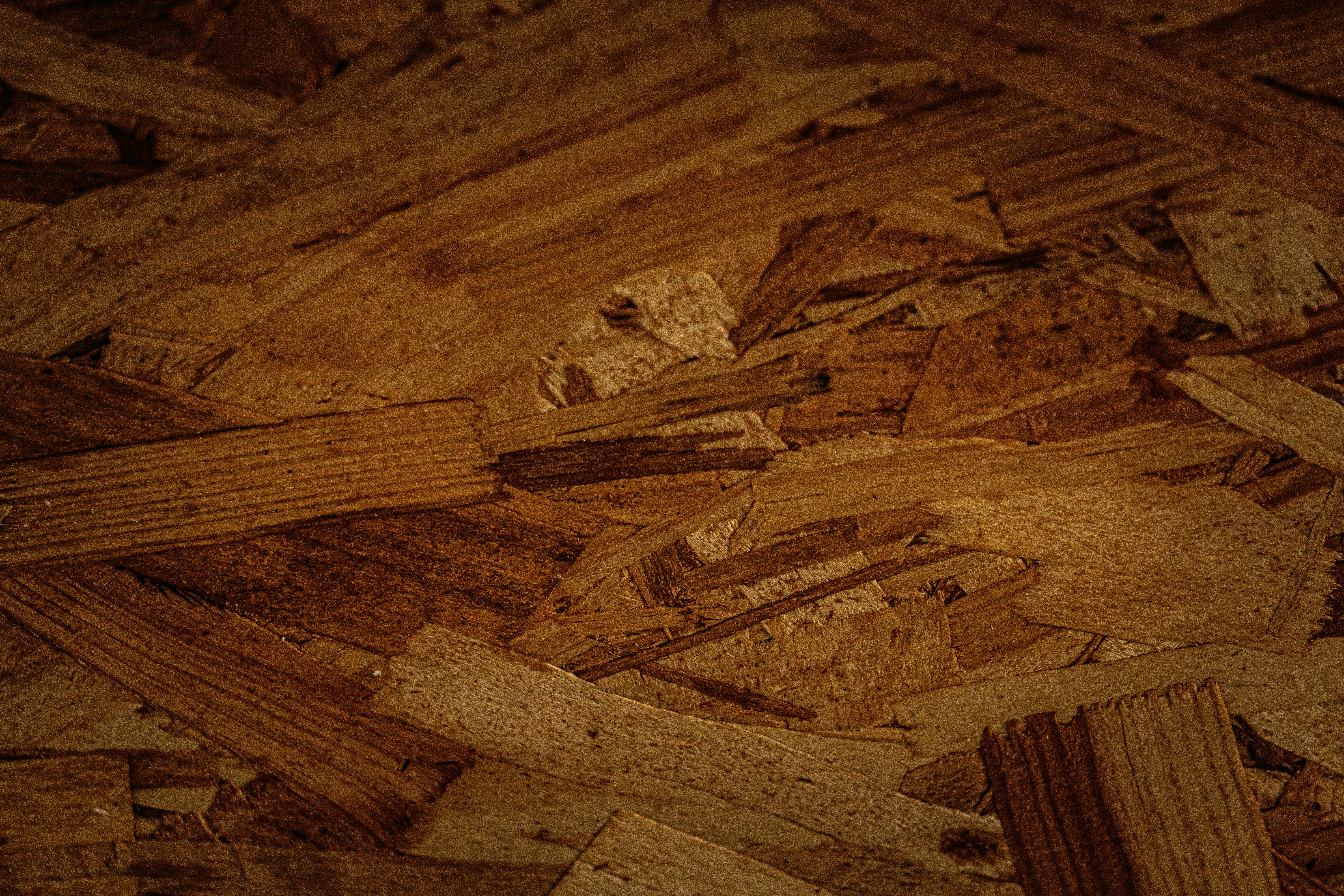
OSB is built from compressed wood strands oriented in alternating layers and bonded with resin. It is cheaper to manufacture, more uniform, and has dominated new construction for roughly two decades. It carries the same span ratings as plywood when properly graded.
The practical difference shows up with moisture. Plywood handles repeated wetting and drying better than OSB because its veneers shed water and dry out without significant swelling. OSB, when water gets past the edges or fasteners, can swell at the edges and lose strength as the resin bonds break down.
Once OSB has been saturated, it rarely returns to its original strength even after drying — and the edge swelling can telegraph through the shingles as a visible bump.
Thickness, Span Ratings, and Code Requirements
Decking is sized for the spacing of the rafters or trusses it is fastened to. In Oklahoma, residential rafter spacing is typically 16 inches or 24 inches on-center, and the minimum decking thickness scales with that span.
Span ratings are printed on every panel as two numbers separated by a slash — for example, 24/16. The first number is the maximum allowed rafter spacing for roof use; the second is the maximum joist spacing for floor use.
For 24-inch on-center trusses, the panel has to carry at least a 24/16 rating, meaning 7/16" OSB or 15/32" plywood is the practical minimum. Most new construction in this market uses 1/2" or thicker panels.
The International Residential Code (IRC) Chapter 8 covers roof sheathing requirements, including allowable spans, attachment, and edge support. Local amendments in Oklahoma jurisdictions can add to these baselines, particularly around fastener type and edge nailing patterns for wind resistance.
Why Decking Damage Is Almost Always Hidden
Here is the central frustration of decking conversations: the damage is real, but it is usually invisible until the existing roof comes off. Several factors explain this.
First, decking sits sandwiched between the shingles above and the attic insulation below. Unless damage breaks through to one side or the other, you cannot see it from the exterior or from inside the attic. A soft spot can develop across an entire eight-foot panel without producing a single visible symptom outdoors.
Second, the damage patterns are slow. Most decking failure in Oklahoma starts from chronic moisture exposure — a slow leak around a chimney, a poorly flashed valley, condensation from inadequate attic ventilation, or wind-driven rain working under a missing drip edge. None of those produce a sudden hole. They produce gradual saturation, which leads to delamination, rot, or fungal decay over years.
Third, hail and wind damage are usually evaluated on the shingles, not the deck. But a hailstone heavy enough to bruise a shingle has also fractured the asphalt mat — and on aging roofs, those fractures are sometimes the start of slow moisture migration into the deck below.
Our guide to spotting roof damage after a Tulsa storm covers what is visible from the ground and what is not.
Signs of Decking Problems You Might See
You cannot diagnose decking from the driveway, but there are a few visible cues that something below the surface is wrong:
Soft, spongy, or springy feel when walking the roof — almost always a sign of saturated or rotted decking, not a flexible shingle
Visible sagging between rafters — indicates the panel has lost rigidity and is deflecting under its own weight
Wavy or rippled shingle lines — often caused by swollen OSB edges or fasteners pulling out of compromised decking
Dark or stained patches in the attic on the underside of the deck — past or current leaks; look for fungal staining, white efflorescence, or active drips after rain
Daylight showing through nail holes from inside the attic — common, not always serious, but worth noting on an inspection
Pulled or "popped" nails visible through the shingle field — sometimes a sign that the deck no longer holds fasteners well
When Decking Has to Be Replaced
Decking replacement is one of those judgment calls that varies by contractor and by inspector. Conservative practice — which is the standard we hold ourselves to — is to replace any panel that is delaminated, rotted, charred, fractured, swollen at the edges to the point it shows through the shingles, or that does not hold fasteners reliably. Anything less is putting a thirty-year shingle on a substrate that will not make it ten.
On most replacements in the Tulsa metro, we plan for somewhere between zero and 15% of the total deck to need replacement, depending on age, ventilation, and storm history. Older homes — pre-2000 — often need more. Homes that were re-roofed without addressing ventilation or flashing failures often need much more.
Decking replacement is typically billed by the sheet, with a per-sheet rate that should be disclosed up front in the proposal. If a quote does not include a decking allowance and replacement rate, that is a red flag.
For a broader look at how line items shape final cost, see our roof replacement cost guide for Tulsa.
How Ventilation Protects Your Decking
Decking longevity is more dependent on attic ventilation than most homeowners realize. Without proper intake at the soffit and exhaust at the ridge, hot humid air gets trapped against the underside of the deck.
In Oklahoma summers, that means 140°F+ attic temperatures cooking the wood from below. In winter, warm moist air condenses on cool sheathing and rots it from the inside out.
A balanced ventilation system, sized correctly for the attic floor area, can add years to the life of both the deck and the shingles above it. The Tulsa attic ventilation guide covers net free area calculations and the most common installation mistakes. The U.S. Department of Energy also publishes a useful overview of attic ventilation principles.
Decking and Storm Claims
When a storm causes structural damage to a roof — hail, wind, fallen limbs, or trees — decking damage may be covered under a homeowner insurance policy. The complication is that adjusters generally cannot see decking damage from the exterior, and many policies require pre-existing damage exclusions.
Damage that pre-dates the storm event is typically not covered, even if the storm finished off a marginal panel.
This is why documentation matters. A pre-loss inspection, attic photos, and date-stamped imagery from previous inspections can support a claim if a storm pushes a borderline deck over the edge.
We help homeowners navigate this regularly through our roof insurance claims service, and our background article on how long you have to file a roof insurance claim in Oklahoma covers the timelines.
What "Decking Replacement" Should Include
Real decking replacement is more than dropping a new sheet on top and nailing it down. A correct replacement includes:
Removing the existing damaged sheet completely, not patching over it
Inspecting the rafter or truss it sits on for collateral damage
Installing the new panel with the correct span rating and exposure category
Maintaining the manufacturer-required 1/8" panel gap for thermal expansion
Nailing on the proper schedule — typically 6 inches on edges, 12 inches in the field, with ring-shank or hot-dipped galvanized fasteners
Re-flashing or re-running underlayment to integrate the new sheet seamlessly with the surrounding field
Anything less is a workaround that may pass a final walk-through but will not last.
Cost Considerations
Decking replacement is usually billed per sheet, with a typical per-sheet rate covering material, labor, and fasteners. In the Tulsa metro in 2026, that rate is generally in the $75-$120 per sheet range depending on accessibility, slope, and the panel thickness specified.
That number can change with material market swings — plywood prices in particular have been volatile since 2020.
On a typical replacement, planning for an allowance of 2-5% of the deck to need replacement is reasonable. Older homes, homes with chronic ventilation problems, and homes with deferred maintenance often run higher.
The honest conversation to have with any contractor is: what is your per-sheet replacement rate, what is included in your initial allowance, and how do you communicate before adding sheets beyond that?
The Bottom Line
Roof decking is the structural foundation of your entire roof system. Plywood and OSB both work when installed correctly and protected by sound flashing and ventilation. The damage that ends a roof early is almost always invisible from the exterior, which is why honest tear-off inspection and clear per-sheet replacement pricing matter more than any other line item in a roofing proposal.
If you suspect decking damage, the right next step is an inspection — not a cosmetic patch. RainTech Oklahoma performs inspection-driven evaluations across the Tulsa metro from our shops in Midtown Tulsa, Bixby, Broken Arrow, Owasso, and Jenks. You can request one through our contact page.
For a wider view of how decking fits into the overall roof system, start with our anatomy of a roof guide or our explanation of the best roofing materials for Tulsa homes. The deck is the part nobody asks about — and the part that determines how the rest of your roof performs.