
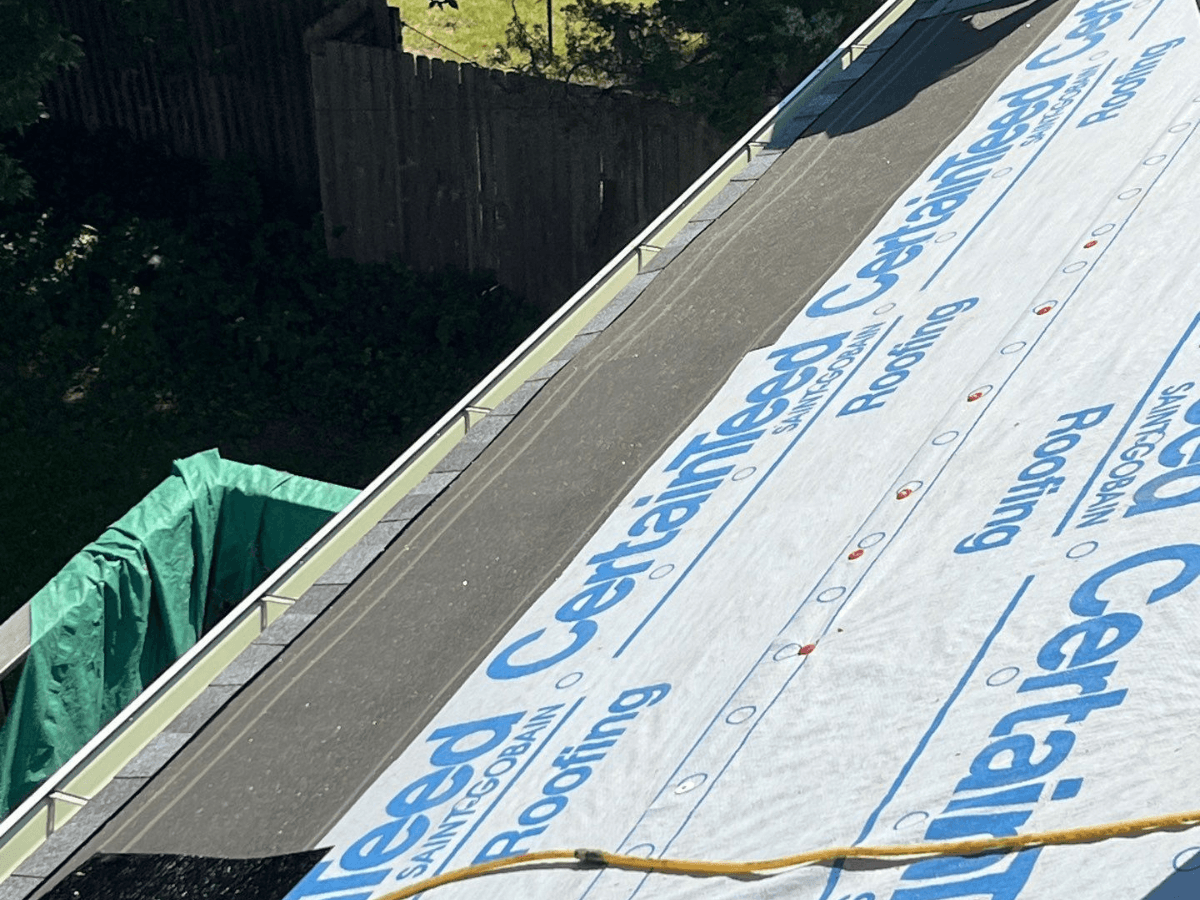
What Is a Drip Edge on a Roof?
A drip edge is one of the smallest, cheapest, and most overlooked components on a residential roof. It is also one of the few parts of a roof that the International Residential Code makes mandatory.
Skip it and you risk rotted fascia, ruined sheathing, and a voided shingle warranty. Install it correctly and most homeowners will never know it is there, which is exactly the point.
This guide explains what a drip edge is, the types installed in Oklahoma, why the 2012 IRC made it a code requirement, how a missing or wrong drip edge voids manufacturer warranties, and what to look for on your existing roof.
If you have ever wondered why a $50 piece of bent metal gets so much attention from roofing inspectors, this is the article that answers it.
For context on where drip edge fits into the rest of the roofing system, see our companion guide on roof underlayment options for Tulsa, since drip edge and underlayment have a critical interaction that determines whether water ends up in your gutter or behind your fascia.
What a Drip Edge Actually Is
A drip edge is a piece of L-shaped or T-shaped metal flashing installed along the perimeter of the roof — at the eaves (the lower edges where the gutter attaches) and the rakes (the angled edges that follow the roof slope at the gables).
It is roughly 10 feet long per piece, lapped at the seams, and folded to direct water away from the underlying wood and into the gutter or off the rake.
Its function is simple and absolute: water hates wood. Anywhere water can sneak behind the gutter or under the shingles at the edge, it will.
Drip edge interrupts that path by giving water a hard, slick, downward-pointing surface to follow. It is one of the few times in construction where a thirty-cent piece of bent metal prevents a thousand-dollar repair.
Drip edge is made from a few different materials — aluminum, galvanized steel, copper, or vinyl — and finished in colors that match common roof and trim palettes.
The standards governing drip edge are published in ASTM A653 for galvanized steel and ASTM B209 for aluminum, with thickness, coating weight, and minimum bend radius specifications.
The Three Profiles: Type C, Type D, and Type F
Drip edge comes in three profile types, named by their shape:
Type C (L-shaped) — the simplest profile, sometimes called L-metal. It has a 90-degree bend with a short top flange and a slightly longer face. Cheap, basic, and acceptable for some applications but not the preferred choice at eaves.
Type D (T-shaped) — also called T-style. It has a top flange that lies on the deck, a vertical face, and a bottom kick-out (the "drip") that throws water away from the fascia. This is the modern standard for eaves on residential asphalt shingle roofs.
Type F (Gutter Apron or Rake Edge) — has an extended top flange, often used on rake edges or as a gutter apron. Longer face allows it to integrate cleanly with gutter systems and address water that runs sideways along the roof edge.
Most quality residential roofing installations in the Tulsa metro use Type D at the eaves and either Type C or Type F at the rakes. The combination provides clean water management on both edges of every roof plane.
Why Drip Edge Has Been Code-Required Since 2012
The 2012 edition of the International Residential Code (IRC) added Section R905.2.8.5, which made drip edge mandatory on asphalt shingle roofs. Before that, drip edge was considered best practice but was routinely omitted by builders trying to save a few hundred dollars per house.
The code change came after decades of fascia rot, premature eave damage, and gutter failures traced back to the same root cause: water wicking backward under the shingles instead of being directed off the roof. Building science research and insurance loss data made the case strongly enough that the model code adopted it.
The IRC requirement specifies that drip edge be: installed at eaves and rake edges; mechanically fastened to the deck (not just relied on by the shingle adhesion above); lapped at joints by at least 2 inches; and integrated with the underlayment correctly — under the underlayment at the rakes and over the underlayment at the eaves. The full code text is available through the International Code Council.
Oklahoma jurisdictions adopt the IRC with local amendments, so the drip edge requirement is enforced uniformly across the Tulsa metro. Any new roof permit pulled in Midtown Tulsa, Broken Arrow, Owasso, Bixby, Jenks, or surrounding municipalities is supposed to include drip edge.
What Drip Edge Actually Does (And What Happens Without It)
Drip edge serves five functions, all related to keeping water away from places it does not belong:
Directs water into the gutter — the kick-out projects water away from the fascia and into the gutter trough, where it belongs
Prevents wind-driven rain intrusion — closes the gap between the shingles and the fascia that wind can otherwise use to push water back under the roof
Supports the shingle edge — provides a continuous straight nailing edge so the first course of shingles does not sag or flutter
Protects the deck from edge moisture — covers the vulnerable cut edge of the sheathing where it is exposed to weather
Keeps insects and small animals out — closes the gap where carpenter bees, wasps, and other pests can colonize the deck edge
Without drip edge, water tracking down the roof has nothing to break its surface tension. It wicks backward along the underside of the shingle, soaks the underlayment edge, and drips behind the gutter. From there it runs down the back of the fascia, into the soffit cavity, and along the sheathing edge — rotting wood the whole way. Over a few years, this damage compounds.
By the time it is visible from the ground as a stained or sagging fascia, the deck behind it is usually unsalvageable.
How Drip Edge Voids Warranties
Most shingle manufacturers — including GAF, Owens Corning, CertainTeed, and Atlas — require drip edge installed per code as a condition of their warranty coverage. A missing drip edge is one of the fastest ways to void a manufacturer warranty, regardless of how new the shingles are.
GAF, for example, publishes installation requirements through their contractor certification program that explicitly require drip edge for warranty validation on their lifetime systems. Owens Corning takes the same position.
When a homeowner files a warranty claim five years after installation and an inspector finds no drip edge, the claim is typically denied — even if the shingles themselves are clearly defective.
This is one of the reasons certification by the shingle manufacturer matters when selecting a contractor. Our roof warranty guide for Tulsa covers the difference between material warranties, workmanship warranties, and system warranties — and what each one actually pays for when something goes wrong.
The Right Way to Install Drip Edge
Correct drip edge installation is not difficult, but the sequencing matters. The most common installation mistakes happen when crews skip the lapping sequence and just nail the metal on as the last step.
At the eaves, drip edge goes on the deck first, before the underlayment. The underlayment then laps over the drip edge top flange, sealing the joint with a downward water path. This sequence prevents any water that gets onto the underlayment from running back under the drip edge.
At the rakes, the sequence reverses. Drip edge goes over the underlayment, not under it. This is because rake water runs sideways, and you want the underlayment to direct water out to the rake drip edge, not under it.
Drip edge should be nailed every 8-10 inches with roofing nails long enough to penetrate the deck by at least 3/4 inch. Joints should be lapped at least 2 inches in the direction of water flow. At corners, the rake piece overlaps the eave piece, and a small bead of roofing cement seals the corner where the two angles meet.
Common Installation Errors
The most common drip edge problems we find when inspecting existing roofs:
No drip edge at all — particularly on pre-2012 roofs and on cut-rate installations
Drip edge installed under the underlayment at the eaves — reverses the water path and lets the underlayment dump water behind the drip edge
Drip edge installed over the underlayment at the rakes — wait, that is the correct way. The error is the opposite — under the underlayment at the rakes, which lets rake water sneak under
Insufficient overlap at joints — less than 2 inches, which can let water find the seam
Fastener pattern too sparse — drip edge that flaps in the wind and eventually loosens
Cheap or undersized profile — Type C used at eaves where Type D should be installed, leaving the kick-out absent
Mismatched color — not a functional issue but a sign of corner-cutting
How to Check Your Drip Edge From the Ground
You can do a basic drip edge inspection from the ground, no ladder required, with the following checks:
Look along the eaves where the gutter is installed. You should see a thin band of metal between the bottom edge of the shingles and the top edge of the gutter. If you see exposed wood — that is the fascia — or no metal at all, you may not have drip edge.
Look along the rake edges of the roof — the slope from peak to eave on the gable ends. You should see a continuous metal edge running the full length of the rake. Gaps, sagging, or missing sections are red flags.
Look for staining or peeling paint on the fascia. Vertical streaks of water staining, paint bubbling, or visible rot are all consistent with a missing or improperly installed drip edge.
Replacing Drip Edge on an Existing Roof
Drip edge is not usually replaced in isolation — it is replaced as part of a roof replacement, because installing it correctly requires lifting the underlayment at the eaves to integrate the new metal under it.
Retrofitting drip edge under existing shingles is possible but rarely produces a watertight result, since the underlayment lap geometry cannot be properly established without lifting the first course.
If your roof is missing drip edge and you are not yet at replacement age, the practical options are: schedule replacement on a normal timeline (typically based on the age and condition of the shingles), retrofit a partial drip edge at the eaves as a temporary measure (acknowledging it is imperfect), or upgrade during the next storm-driven replacement event.
Our guide on roof repair vs. replacement in Bixby walks through that decision in more depth.
Cost of Drip Edge as a Line Item
Drip edge is one of the cheapest line items on a roofing proposal. Material cost runs roughly $1-$3 per linear foot in 2026. A typical 2,000-square-foot home has 150-250 linear feet of eave and rake perimeter, putting the total material cost between $150 and $750. Labor to install adds modestly — drip edge is fast to put up — and the line item rarely exceeds 1-2% of a total replacement.
Yet it is one of the most consequential line items in the package. Any quote that does not specify drip edge by type and material is a quote that may or may not include it. Reading the proposal carefully — or asking the contractor directly — is the only way to know.
The Bottom Line
Drip edge is required by code, required by every major shingle manufacturer warranty, and is one of the highest-leverage components on the roof relative to its cost. A correctly installed drip edge directs water into the gutter where it belongs, protects the fascia and deck edge from chronic moisture, and keeps your warranty intact.
A missing or wrong drip edge is the slow-motion start of a damage cascade that ends in rotted wood and denied warranty claims.
If you are evaluating a roofing proposal or have questions about whether your existing roof has proper drip edge installation, an inspection is the right next step. RainTech Roofing works across the Tulsa metro in Midtown Tulsa, Owasso, Bixby, Broken Arrow, and Jenks. Request an inspection through our contact page and we will document the condition of every edge, eave, and flashing detail on your home.