
Commercial Roof Coatings in Broken Arrow: Restore Without Replacing
The conversation usually starts the same way. A Broken Arrow building owner is facing a $250,000 roof replacement bid for a 25,000 sq ft commercial building. The roof is 18 years old. There are some leaks, but the building manager has been keeping ahead of them. The structure underneath is sound. The roofer has quoted full tear-off and TPO replacement.
And then someone — maybe a different contractor, maybe a friend in the industry, maybe an article like this one — asks the question: has anyone evaluated whether a coating restoration would extend this roof another 15 years?
For the right buildings, that question saves owners hundreds of thousands of dollars while delivering most of the practical benefits of replacement. For the wrong buildings, it’s a band-aid that delays the inevitable. Knowing the difference is what this guide is about.
Here’s the practical reality of commercial roof coatings in Broken Arrow: when they make sense, when they don’t, what the work actually involves, what it costs, and how to make sure the restoration delivers what you’re paying for.
What a Roof Coating Actually Is
A roof coating is a liquid-applied membrane that bonds with an existing roof surface to create a new continuous waterproof barrier. Coatings come in several chemistries:
Silicone coatings
The most popular for commercial restoration in our market.
Pros: - Excellent UV resistance - Doesn’t degrade in standing water (better ponding tolerance than other coatings) - High reflectance - Long lifespan (15-25 years for quality applications) - Compatible with most existing roof systems
Cons: - More expensive than acrylic - Difficult to recoat (silicone doesn’t bond well to itself; future maintenance more complex) - Can be slippery when wet
Acrylic coatings
Traditional choice, well-established in the market.
Pros: - Lower material cost - Easy to recoat - Good reflectance - Wide applicability
Cons: - Doesn’t tolerate ponding water as well as silicone - Shorter lifespan than silicone in harsh conditions (10-15 years typical) - More vulnerable to UV degradation over time
Urethane coatings
Premium specialty option for specific applications.
Pros: - Excellent flexibility - Very durable in high-traffic areas - Good chemical resistance
Cons: - Most expensive option - Complex application requirements - Strong odor during application
SPF (Spray Polyurethane Foam) with coating
A different approach — sprayed foam insulation with a protective coating on top.
Pros: - Adds significant insulation value - Self-flashing around penetrations - Excellent for irregular surfaces
Cons: - More invasive process - Requires specialty training - Higher upfront cost
For most Broken Arrow commercial buildings, the choice comes down to silicone vs. acrylic, with silicone being the more common premium choice in our climate.
When Coating Makes Sense
A coating restoration is the right call when several conditions align:
The existing roof is structurally sound
The decking is solid, the insulation is mostly dry, the framing isn’t compromised. Coating extends the membrane life; it can’t fix structural issues.
The membrane is aged but intact
The existing TPO, EPDM, modified bitumen, BUR, or metal roof is past its prime but hasn’t failed wholesale. Surface aging, granule loss, minor cracking — coating restores these. Catastrophic membrane failure does not respond to coating.
Drainage is functional
Water drains properly off the roof. Areas of significant ponding are problematic for coatings, particularly acrylic. Silicone tolerates ponding better but isn’t unlimited.
Insulation is mostly dry
Wet insulation under the membrane is a problem coatings can’t solve. A moisture survey before coating is critical to identify wet areas that need replacement before coating.
Penetrations and details are repairable
The flashings around HVAC, vents, and other details need to be sound or repairable. Coatings can integrate with reinforced flashings, but they don’t compensate for failed flashing systems.
The building owner wants to extend the roof’s life by 10-20 years
Coatings deliver 10-20 years of additional service life. Owners planning to replace within 3-5 years anyway might not benefit; owners planning to keep the building 15+ years generally do.
When Coating Doesn’t Make Sense
A coating is the wrong call in these situations:
Widespread membrane failure
If the existing membrane has failed in multiple areas, with significant punctures, large seam separations, or visible deterioration, coating won’t fix the underlying problems. Full replacement is needed.
Saturated insulation across most of the roof
If a moisture survey shows widespread wet insulation, the coating goes on top of a problem that compounds. The wet insulation continues to degrade decking, attracts mold, and can’t dry under a new coating.
Heavy ponding water without drainage correction
Coatings tolerate some ponding, but consistent standing water compromises any coating system. Drainage corrections must precede coating in significant ponding situations.
Building scheduled for major modifications
If the building is being expanded, restructured, or having major rooftop additions, coordinating with those changes is more economical than coating-then-modifying.
Very short remaining hold
If the building is being sold or demolished within 3-5 years, the coating premium might not be recovered.
Code-mandated insulation upgrades
If your building requires insulation upgrades to meet current code, those happen during full replacement, not coating restoration. Coating doesn’t trigger code upgrade requirements but doesn’t address them either.
What the Work Actually Looks Like
A quality coating restoration in Broken Arrow follows a standard process:
Step 1: Assessment and moisture survey
Before any work begins:
Full visual inspection
Moisture survey (infrared, capacitance, or test cuts) to identify wet insulation
Drainage analysis
Penetration evaluation
Seam testing
Documentation of existing conditions
This assessment determines whether coating is appropriate and what prep work is needed.
Step 2: Prep work
The biggest variable in coating quality. Proper prep includes:
Surface cleaning — pressure washing, removal of dirt, debris, biological growth
Wet insulation replacement — areas identified by moisture survey as wet need to be cut out, replaced, and re-membraned before coating
Seam reinforcement — failing seams or seams with concerns get reinforcing fabric and patching
Flashing repair or replacement — penetration flashings, edge metal, wall flashings restored or replaced
Drainage correction — drains cleaned, scuppers cleared, ponding addressed where possible
Primer application — many coating systems require a primer specific to the existing roof type
Skipping or shortcutting prep is the most common reason coating systems fail prematurely. A coating only works on a properly prepared surface.
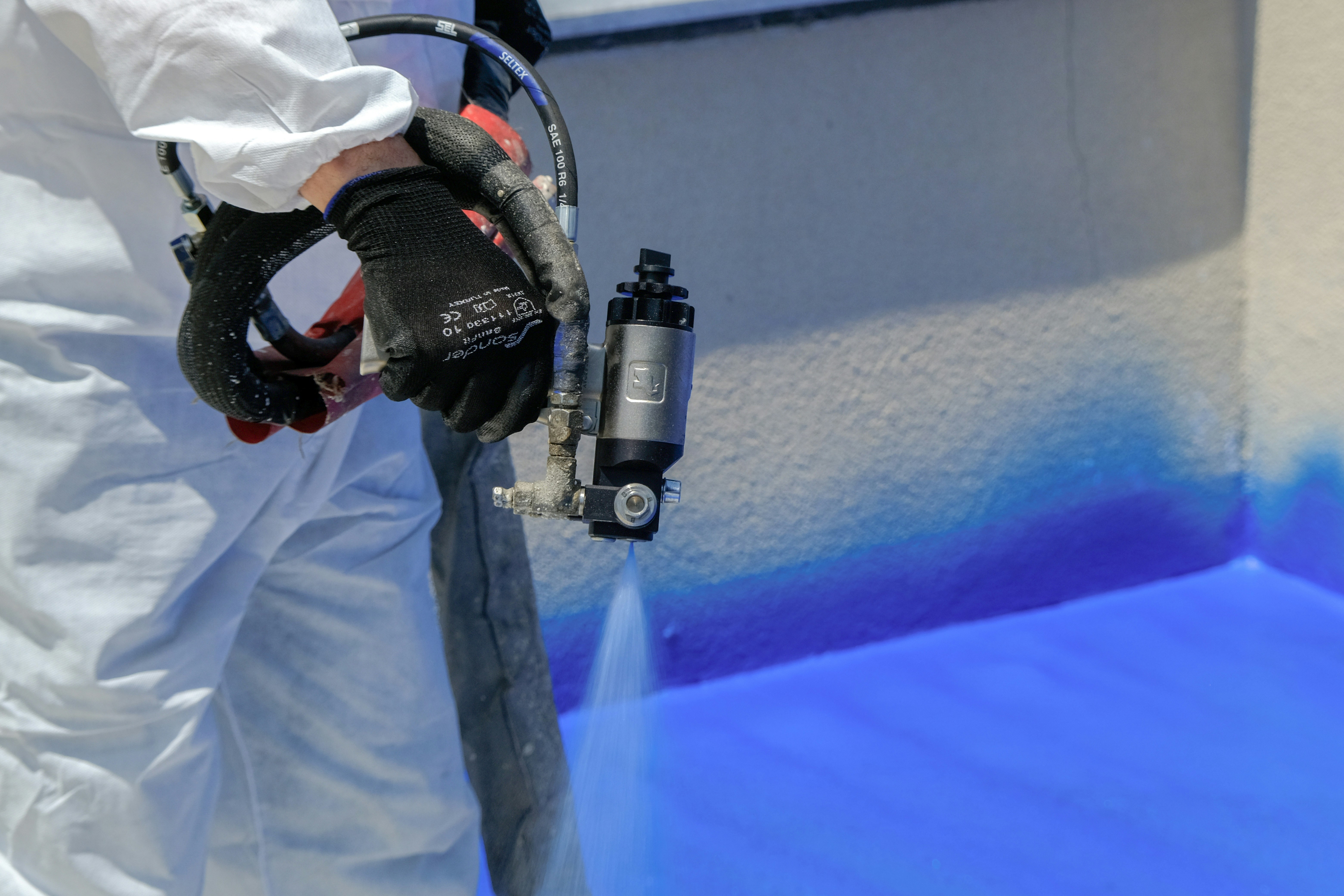
Step 3: Coating application
The coating itself goes on in two coats minimum:
Base coat at specified mil thickness
Top coat at specified mil thickness
Reinforcing fabric at all transitions, seams, and details
Total dry film thickness typically 30-50 mils for silicone, similar for acrylic
The thickness matters dramatically. A 25-mil application of silicone is not the same product as a 40-mil application. Verify the spec.
Step 4: Inspection and warranty
After completion:
Manufacturer rep inspection (for system warranties)
Documentation of application
Warranty issuance — typically 10-20 years for system warranties
Maintenance program established
The whole process takes 2-5 days for a typical Broken Arrow commercial building (much faster than full replacement) and doesn’t require business interruption.
Cost Reality for Broken Arrow Buildings
For a typical commercial building in Broken Arrow in 2026:
Coating restoration
Silicone, mid-grade application: $4-$6 per sq ft
Silicone, premium thickness with full prep: $6-$9 per sq ft
Acrylic, mid-grade: $3-$5 per sq ft
For a 25,000 sq ft building:
Silicone restoration: $100,000-$225,000
Compare to: $175,000-$375,000 for new TPO replacement
The savings are typically $50,000-$150,000 on a 25,000 sq ft building, with the coating delivering 15-20 years of additional life vs. 25-30 for new replacement.
When the math really works
Coating economics are most favorable when:
The existing roof is at year 15-20 of a 25-30 year potential lifespan
The building owner plans to hold the property long-term
The structural condition is sound
The required prep work is reasonable (not overwhelming)
Under these conditions, coating extends useful life dramatically while saving substantial capital.
Tax and Accounting Considerations
Commercial roof coatings have a different tax treatment than full roof replacement, which can be financially meaningful:
Coating as repair/maintenance expense
In many cases, coating restoration can be treated as repair/maintenance for tax purposes — deductible in the year incurred rather than capitalized over decades.
New roof as capital expenditure
A full roof replacement is typically capitalized and depreciated, with deductions spread over many years.
Section 179 implications
Recent tax law has expanded Section 179 expensing for commercial roof improvements (over $1 million in some cases). The specific application to coating vs. replacement varies and should be reviewed with your accountant.
The tax treatment can effectively reduce the net cost of coating restoration by 20-30% relative to capitalized replacement. Consult your tax professional for your specific situation.
The Quality Question: Choosing the Right Coating Contractor
Coating restoration is a more specialized skill than basic membrane installation. Many roofing contractors don’t actually do coating work; the ones that do vary widely in quality.
What to look for:
Manufacturer certification
Major coating manufacturers (Henry, GAF, Sika, Garland, Conklin, Mule-Hide, etc.) certify contractors for their systems. Manufacturer-certified contractors:
Have completed training programs
Are required to maintain quality standards
Can offer manufacturer-backed warranties (often 10-20 year)
Documented coating experience
Specific portfolio of completed coating restorations on similar buildings. Photos, references, contact info for completed projects.
Proper diagnostic approach
A contractor proposing coating without first conducting a moisture survey and prep assessment is taking a shortcut you’ll pay for.
Realistic warranty terms
10-20 year warranties on quality coating systems are the norm. Be skeptical of either much shorter (5 years on a major system suggests low confidence) or unrealistically long (lifetime coatings without specific manufacturer backing).
Detailed scope with specifications
Just like commercial roof installations, coating quotes should specify exact products, mil thickness, prep scope, and warranty terms.
Common Coating Failures (and How to Avoid Them)
A few patterns that cause coating restorations to fail:
Inadequate prep
The single biggest cause of coating failure. Coating on a dirty, contaminated, or improperly prepped surface fails within 2-5 years instead of 15-20.
Wrong coating for the existing roof
Some coatings don’t bond well to certain existing roofs. Compatibility verification matters.
Insufficient mil thickness
Spec calls for 40 mils total dry film, but actual application is 25 mils. The product label says one thing; the actual roof has another. Quality contractors verify thickness with wet film gauges during application.
Skipping reinforcement details
Transitions, penetrations, and seams need reinforcing fabric in the coating system. Skipping fabric saves money during install but fails first.
Applying over wet insulation
Coating over wet insulation traps the moisture, accelerates decking damage, and grows mold under the new system.
Poor weather conditions during application
Coatings have specific temperature and humidity requirements during application and cure. Applying outside the spec window compromises the result.
Get a Coating Restoration Assessment
If you have a commercial building in Broken Arrow with an aging but structurally sound roof and you want to evaluate whether coating restoration is the right path — schedule a free commercial roof inspection with our team.
Our coating restoration assessments include:
Full roof condition evaluation
Moisture survey to identify wet insulation
Drainage analysis
Cost comparison: coating restoration vs. full replacement
Realistic lifespan projections for each option
Manufacturer warranty options
Honest recommendation about which path makes sense for your building
For Broken Arrow commercial buildings where coating is the right call, the savings vs. full replacement are substantial — often $100,000+ on mid-size buildings. Where it’s not the right call, we’ll tell you that too.
We’re not selling coating because it’s our biggest revenue line. We install full new roof systems on the buildings that need them. We recommend coating on the buildings where it actually makes sense. The honest assessment is more valuable than the biggest sale.
Schedule Your Free Broken Arrow Commercial Roof Assessment →